What Is Biostatistics?
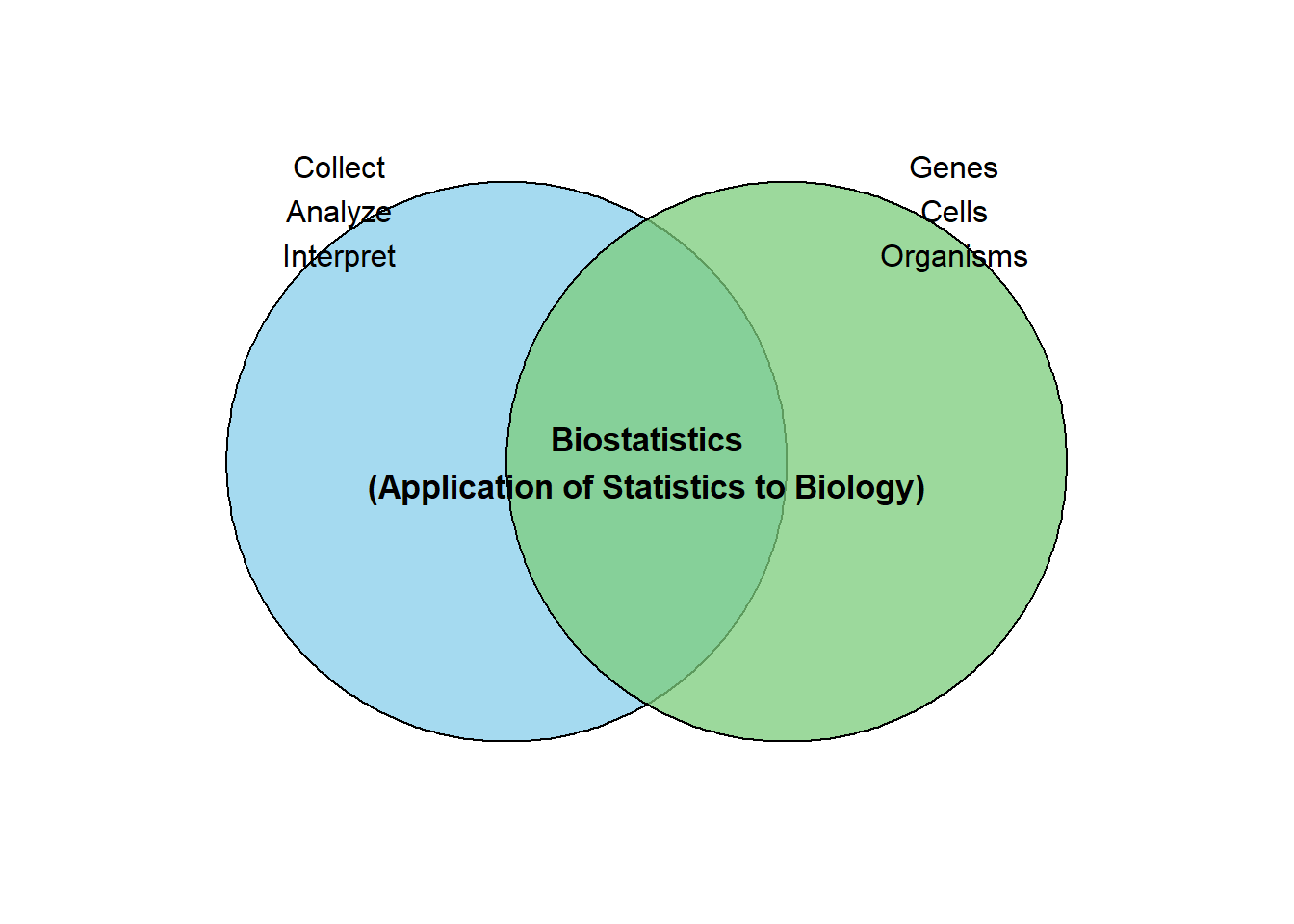
Biostatistics is the branch of statistics that applies statistical reasoning, methods, and tools to biological and health-related problems.
In simple terms, biostatistics turns biological data into understanding. It helps researchers summarize information, test hypotheses, and make conclusions that are scientifically and ethically sound.
Biostatistics connects:
Biology → the study of life
Statistics → the science of data
to draw reliable conclusions about living systems.
Example Scenarios
Estimating the average blood pressure in a population.
Comparing treatment outcomes between two patient groups.
Exploring whether gene expression correlates with disease severity.
Studying the effect of pollutants on aquatic species.
Each of these examples involves data, variability, and uncertainty — all core to biostatistics.
The Role of Biostatistics in Research
Biostatistics supports every stage of scientific inquiry:
| Stage | Purpose | Example |
|---|---|---|
| Study Design | Plan how to collect and compare data | Randomized control trial design |
| Data Collection | Ensure representative and unbiased sampling | Clinical data, lab assays |
| Data Visualization | Display trends and patterns | Boxplots, histograms |
| Analysis | Apply statistical tests and models | t-tests, regression |
| Interpretation | Draw conclusions based on probability | “This result is statistically significant” |
Why Biostatistics Matters
- Understanding Variability
Biological data are inherently variable. Biostatistics helps separate real biological effects from random noise.
- Making Evidence-Based Decisions
In medicine, public health, and life sciences, decisions must be supported by statistical evidence and not just intuition.
- Ensuring Reproducibility
A statistically sound analysis ensures that results are reproducible and generalizable to larger populations.
- Ethical Efficiency
Good statistical design avoids wasted resources and unnecessary use of animals or patients in research.
Key Takeaways
Biostatistics bridges biology and data science.
It provides structure and rigor to scientific inquiry.
Good statistical reasoning ensures valid, reproducible, and ethical conclusions.
In an era of “big data,” the ability to think statistically is essential for every biologist.
Further Reading
Motulsky, H. (2018). Intuitive Biostatistics (4th ed.). Oxford University Press.
Rosner, B. (2015). Fundamentals of Biostatistics. Cengage Learning.
Altman, D. G. (1991). Practical Statistics for Medical Research. Chapman & Hall.